All photos and text by Jack Rothman. All rights reserved. No photo may be copied or duplicated without written permission. Copyright 2025.
Updated 12/29/25
City Island Birds
Since 2007
Welcome to City Island Birds. My name is Jack Rothman. I created this website and birding club because this area of New York City is little known and underutilized by birdwatchers and other nature lovers. Pelham Bay Park, with its woods and wetlands is a critical stopover and nesting area to many migratory species.
Our Mission
City Island Birds was created in 2007 to bring birders, and would be birders, to the park. Everyone has always been and always will be welcome. Our walks are always inclusive, friendly, non-competitive, fun and free. We all love to see great birds, but without each other, it's never as enjoyable.
Saul's Science Watch
My birding buddy Saul has been writing wonderful science articles for the Hudson River Audubon Society. You can link for years of wonderful insights and information. Just scroll to the bottom of the page for a complete list of the articles.
Five Quick Beginning Birding Suggestions
1. Go out with a group or an experienced leader. You'll learn how to use binoculars, find birds, meet interesting and friendly people.
2. Wear appropriate clothes. Weather is always a little more extreme in open spaces. Don't wear your brand new $200 running shoes. It can be muddy.
3. Most leaders have binoculars to lend if you don't have your own. Opera glasses are pretty useless for birding. If you want to buy a pair, email me and I will make suggestions depending on your budget.
4. Bring a snack and water. Most walks are a few hours. You'll see that birding is not fast walking. Expect to be moving slowly.
5. Get a portable field guide to bring with you when you bird alone. Use it at home too. Look for the Peterson or Sibley guide.
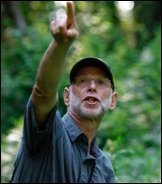
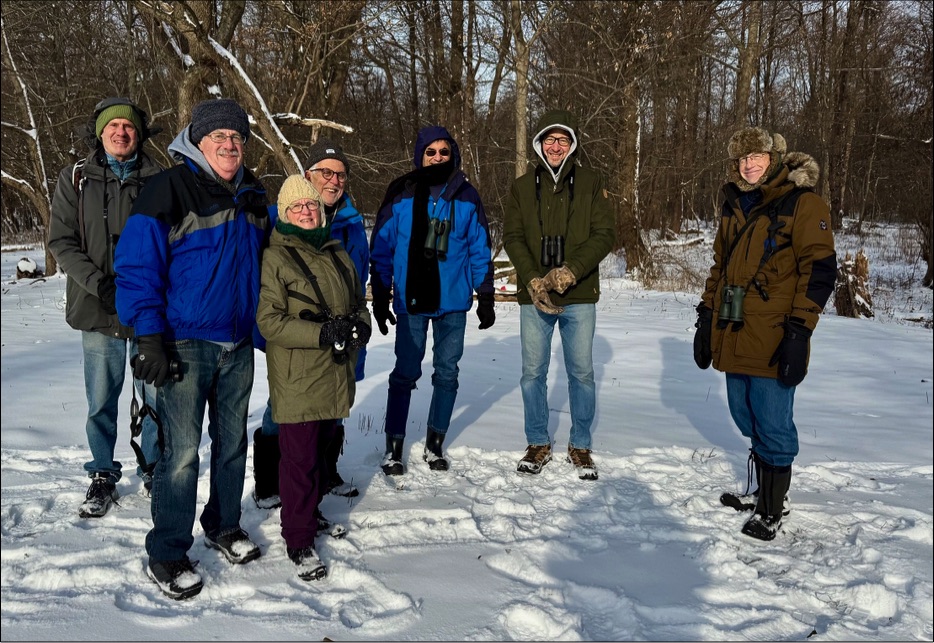
Our Rodman's Neck group for the 2025 Christmas Bird Count. This was really a fun time and there was great comradery as we traisped through the woods.When I woke in the early morning, it was 17 degrees and I was thinking, "Why am I doing this, it's crazy." When I arrived it was 7:15am, cold, crisp and truly beautiful. There was no wind and we walked through the pristine snow and to the nearby water searching for anything with wings. We tallied 29 species and finished in about 3 hours. For me, this was one of the best Christmas counts ever. The beauty of nature and the wonderful people made it so.
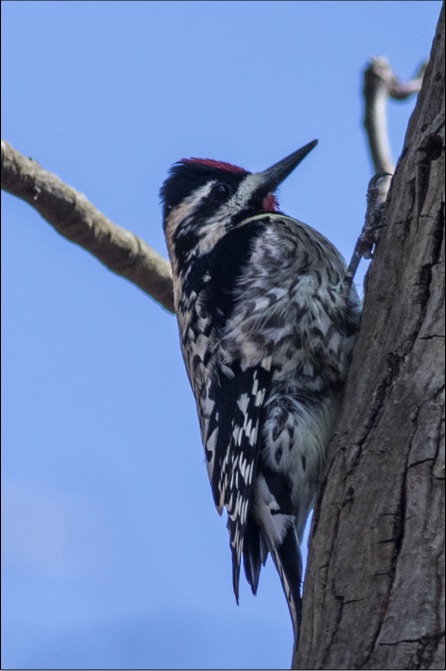
Always seem hard to photograph, the Yellow-bellied Sapsucker.
Names Given To Groups of Birds
Based on History and Literature
From The Verb To Bird, Peter Cashwell (Paul Dry Pub. 2003)
A gaggle of geese ( in water)
A charm of finches
A tiding of magpies
A descent of woodpeckers
A mustering of storks
A parliament of owls
A host of sparrows
A siege of herons
An unkindness of ravens
A cast of hawks
An ostentation of peacocks
A murder of crows
A walk of snipe
From An Exaltation of Larks, James Lipton (Penguin pub. 1993)
A party of jays
A gatling of woodpeckers
A murmuration of starlings
(in air)
A clutter of starlings
(on ground)
A mutation of thrushes
A fall of woodcock
A skein of geese (in air)
An exaltation of larks
A shimmer of hummingbirds
A spring of teal ( ducks)
A sorde of mallards
A rafter of turkeys
A descent of woodpeckers
A convocation of eagles
A leash of merlins
Upcoming Birding Tours with Jack
Join me for the annual Christmas Bird Count on December 28. I will be birding the Rodman's Neck area near City Island. Please contact me at jack@cityislandbirds.com. Both new and experienced birders are welcome!
A good looking female Red-breasted Merganser. Usually by this time we have dozens in the water off Hunter island but there are only a few so far this year.
Pete Dunne, in his book, Pete Dunne on Bird Watching: The How-to, Where-to and When-to of Birding:
"The difference between a beginning birder and an experienced one is that beginning birders have misidentified few birds. Experienced birders have misidentified thousands."
A terrific ABA blog post called "Birding is Hard" from April 22, 2015 can be found here.
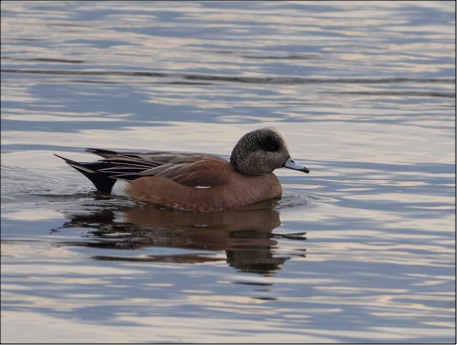
An American Wigeon hanging out along the shoreline beween Orchard Beach and the City island Bridge. There was a nice mix of ducks at that location.
Looing forward to seeing lots of waterfowl this winter. So far the surrounding waters have had some "duckage" but not as populated as past winters. The weather's been so windy and cold I haven't been out as much as usual. Last week were Loons, Scaup, RB Merganser, American Black Ducks, Grebe etc but in small numbers.
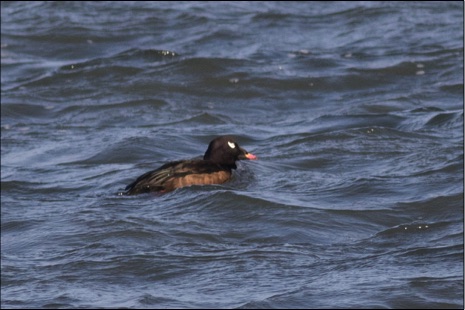
A White-winged Scotor off Orchard Beach. They were here earlier in the season but seemed to have moved on. I hope they return. Identified by the "comma" above their eye.
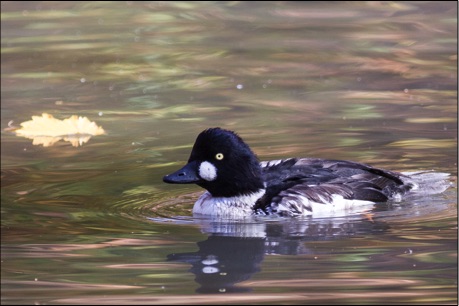
Common Goldeneye are generally very far out off Twin Island. I was lucky to get this shot.
American Wigeon hang out on the very south end of Orchard Beach. Easiest to find them is to walk over the City Island bridge and turn right along the trail that is parallel to the shoreline.
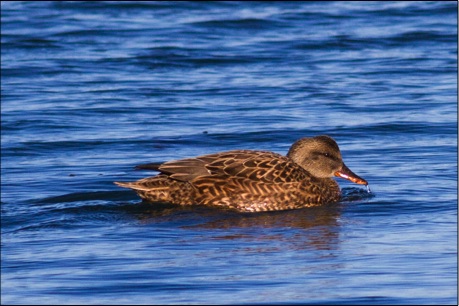
I love the feathering on the Gadwall, so beautiful. Sometimes they're at Turtle Pond.
A male "Hoodie" or Hooded Merganser. They were reliable sightings at Turtle Pond but not so much anymore. Often a Van Cortlandt Park lake.
A Common Loon in non-breeding plumage. Notice how the white extends around the side of his neck. This makes identification from a distance easier. Sibley calls this a "partial collar." The loon on the right is a Red-throated Loon. The white doesn't wrap around the side of the neck.
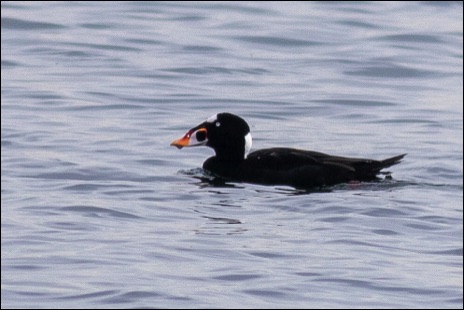
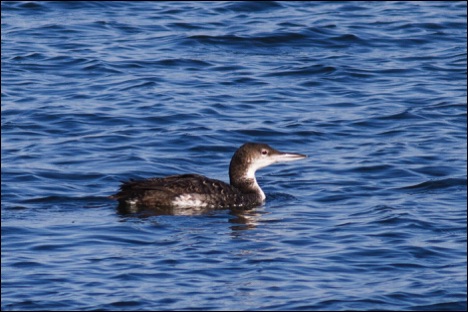
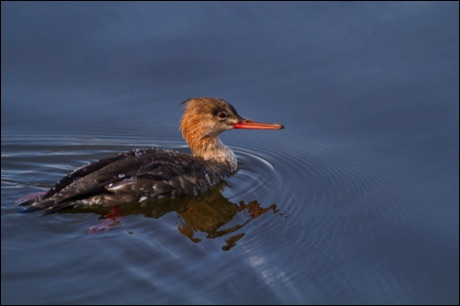
Another Scoter that was here is the Surf Scoter. They too have moved on. They have the most unusual beaks. That beak, along with the patch of white in back of their head helps to identify them in the distance.
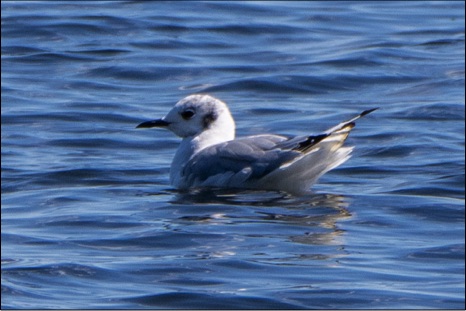
I'm not great at identifying gulls. This one is not too difficult, small thin bill, small size and the black patch behind it's eye makes it easier than others. It's a Bonaparte's Gull.
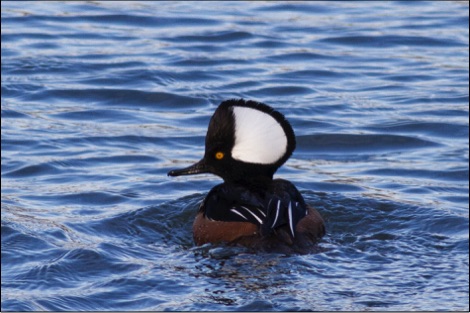
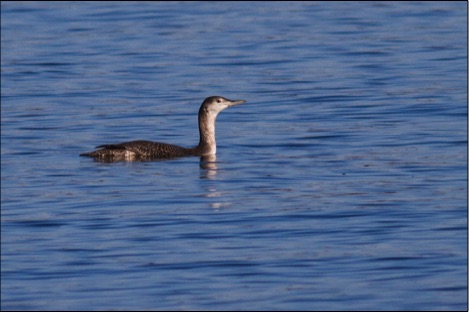
Both the Red-throated Loon, pictured here, and Common Loon are usually spotted off Orchard Beach, Twin and Hunter islands. The bird doesn't have a "partial" collar and the bill of this bird is usually tilted more upward.
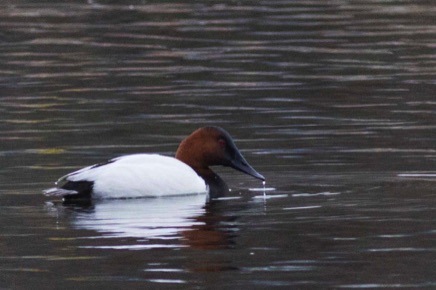
A beautiful male Canvasback. This photo was taken at Playland lake in Rye in January 2012. The last time I saw one here was 2019. There used to be many but few migrate here now.